By Slattery Moving & Storage
Last Updated: 2026
The Quick Answer: Would You Recommend Living in Rockland County?
Yes, but with a financial tradeoff. If you prioritize top-tier public school systems, safe suburban neighborhoods, expansive Hudson Valley parks, and a manageable 35-to-60-minute commute to New York City, Rockland County is easily one of the most rewarding places to live in the tri-state area.
However, the cost of living is 39% above the national average. If your household income can support $185,000+ per year, Rockland offers an unmatched balance of suburban peace, outdoor adventure, and urban accessibility.
Nestled along the western bank of the Hudson River just 25 to 30 miles north of Midtown Manhattan, Rockland County is New York State’s smallest geographic county outside the NYC boroughs. Covering 176 square miles and five major towns—Clarkstown, Orangetown, Ramapo, Haverstraw, and Stony Point—it serves as the quiet, green gateway between New York City, Northern New Jersey, and the Hudson Highlands.
If you are evaluating whether to move here, this guide combines the essential elements of everyday residential life, town-by-town selection, local logistics, and community landmarks into a single resource.
1. Choosing Your Community: Best Towns for Different Lifestyles
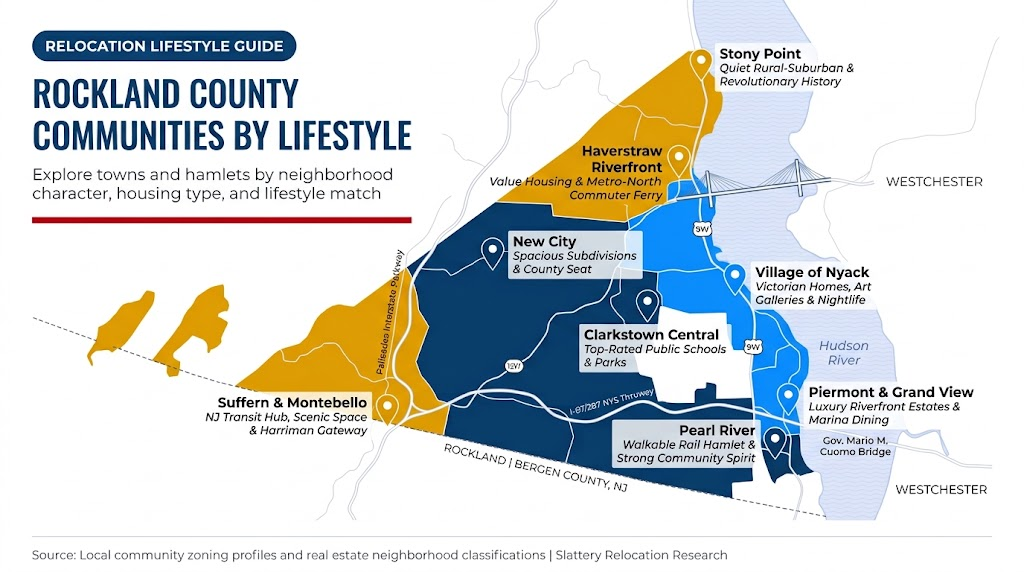
Rockland’s personality changes significantly from the historic river bluffs in the east to the mountain border communities in the west.
| Town / Hamlet | Best Suited For | Median Single-Family Price | Defining Character |
| New City & Clarkstown | Families seeking top schools & suburban yards | $720,000 – $830,000 | Quiet subdivisions, expansive municipal parks, civic hub. |
| Nyack & South Nyack | Young professionals, creatives & foodies | $750,000 – $925,000 | Walkable historic downtown, art galleries, river views. |
| Pearl River & Blauvelt | Commuters & community-centered families | $680,000 – $775,000 | Strong Irish-American heritage, direct NJ Transit train, pub culture. |
| Suffern & Montebello | Commuters needing transit hubs & scenic space | $580,000 – $690,000 | Gateway to Harriman State Park, train station, diverse dining. |
| Piermont & Grand View | Luxury buyers & waterfront dining enthusiasts | $850,000 – $1,300,000+ | Marina living, historic pier, fine dining corridor. |
| Haverstraw & Stony Point | Value buyers & scenic history seekers | $460,000 – $550,000 | Entry-level pricing, commuter ferry, deep Revolutionary roots. |
2. Real Estate & The Cost of Living Reality
Navigating life in Rockland means understanding housing dynamics and recurring tax obligations.
- Homeownership: Single-family homes range from classic mid-century ranches and split-levels in Clarkstown to historic Victorians in Nyack and sprawling multi-acre estates in Montebello. Countywide median sale prices sit around $765,000–$777,000.
- Rentals: One-bedroom apartments average $2,100 to $2,550/month, while two-to-three-bedroom layouts range from $2,700 to $3,400+/month.
- Property Taxes: Rockland’s effective property tax rate averages 2.45% to 2.85%. On a $700,000 home, expect annual property tax escrow bills between $17,150 and $19,950. Roughly 60%–65% goes directly toward funding the local school districts.
For a detailed breakdown of monthly bills, grocery prices, utility averages, and comparisons to Westchester and Orange County, explore our comprehensive guide: Cost of Living in Rockland County: 2026 Relocation Breakdown.
3. Public Safety & Crime Rates
Safety is consistently one of the primary reasons city dwellers relocate here.
- National Standing: U.S. News & World Report officially ranked Rockland the #3 Safest County in the United States, awarding it a 93.86/100 public safety score.
- Crime Numbers: Violent crime stands at 121.5 per 100,000 residents—more than 50% below the national average of 255.2.
- Property Offenses: The vast majority of incidents are non-violent larceny or vehicle-checking along busy commercial routes (Route 59) rather than neighborhood residential break-ins.
Want neighborhood-by-neighborhood crime grades and safety comparisons against Bergen and Westchester? Read our full report: Is Rockland County Safe? Crime Stats, Safety Grades & FAQs.
4. Schools & Education
Rockland is renowned across New York State for high-performing, well-funded public school districts:
- Clarkstown Central School District: Anchored by Clarkstown North and South High Schools; known for extensive AP course offerings, high graduation rates, and strong athletics.
- South Orangetown Central School District: Home to Tappan Zee High School, earning consistent praise for STEM programs and student mentorship.
- Pearl River & Nyack Public Schools: Pearl River offers strong community involvement and neighborhood school hubs; Nyack offers progressive arts, music curricula, and diverse student bodies.
- Higher Education & Vocational Programs: Includes Rockland Community College (RCC) in Suffern (nationally noted for its SUNY honors transfer pipeline) and specialized technical training via Rockland BOCES.
5. Transportation, Commuting & Travel
While Rockland feels peaceful and rural-suburban, it was built around commuter access to Manhattan, Westchester, and North Jersey.
Driving Corridors & Bridges
- Palisades Interstate Parkway (PIP): Offers a scenic, commercial-vehicle-free drive straight south to the George Washington Bridge (30–45 minutes off-peak).
- NYS Thruway (I-87 / I-287): Runs east-west through the center of the county, taking drivers directly across the Gov. Mario M. Cuomo Bridge to Tarrytown and Westchester.
- Route 59 & Route 9W: The primary commercial retail corridor (Route 59) and the historic, scenic riverfront connector (Route 9W).
Public Transit to NYC
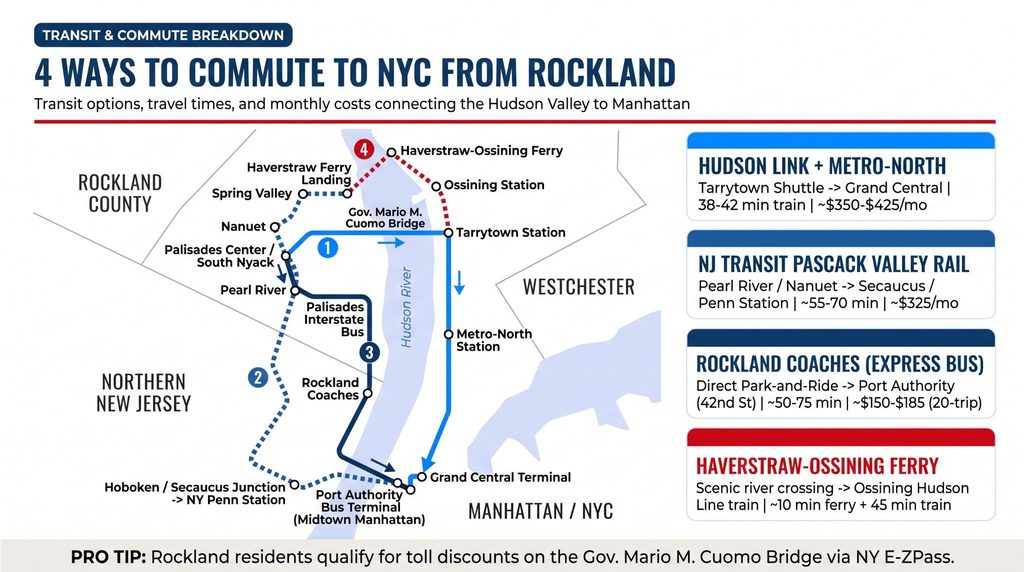
- Metro-North Hudson Line (via Tarrytown): Drive across the Cuomo Bridge or catch the Hudson Link Bus to Tarrytown Station; express trains reach Grand Central Station in 38–42 minutes.
- NJ Transit / Pascack Valley Line: Direct train service from Pearl River, Nanuet, and Spring Valley into Hoboken (with PATH train transfer) or direct one-stop transfers at Secaucus Junction into NY Penn Station (approx. 60–75 minutes).
- Commuter Express Buses: Rockland Coaches (Coach USA) provide direct, single-seat motorcoach service from town park-and-ride lots into Port Authority and Midtown Manhattan.
- Haverstraw-Ossining Ferry: A weekday commuter ferry connecting northern Rockland across the Hudson directly to the Ossining Metro-North train platform.
6. Weather & Four-Season Climate
What is the weather like in Rockland County throughout the year? Rockland experiences a classic humid continental Northeastern climate, characterized by four distinct seasons:
- Spring (April – May): Highs range from 55°F to 72°F. Trees blossom along the Hudson, and local farm stands reopen.
- Summer (June – August): Warm and moderately humid, with daytime temperatures averaging 80°F to 88°F. Residents spend summers boating on the Hudson, swimming at Rockland Lake State Park, or exploring shaded mountain trails.
- Fall (September – November): The county’s standout season. Cool, crisp temperatures (50°F–68°F) pair with world-renowned fall foliage across Bear Mountain and Seven Lakes Drive.
- Winter (December – March): Cold, with highs averaging 32°F to 42°F. Rockland typically receives 28 to 36 inches of snowfall annually. Coastal storms (Nor’easters) bring snow to higher elevations around Harriman, where cross-country skiing and winter hiking are common.
7. Healthcare & Essential Public Services
Rockland County provides an advanced healthcare network with robust municipal emergency coverage:
- Hospital Anchors:
- Montefiore Nyack Hospital: A certified Level III Trauma and Stroke Center located directly on the eastern side of the county.
- Good Samaritan Hospital (Suffern): A verified Level II Trauma Center with dedicated cardiovascular, surgical, and maternity wings.
- First Responders: Rockland maintains a dedicated volunteer infrastructure consisting of 14 Basic Life Support (BLS) corps, Advanced Life Support paramedic intercepts, and 26 local volunteer fire departments operating through the county’s Fire Training Center in Pomona.
- Public Libraries & Recreation: Every major town features its own modern library system (with reciprocal borrowing across the Ramapo Catskill Library System) offering community co-working spaces, children’s story hours, and senior programs.
8. Sights, Landmarks & Must-Visit Destinations
Rockland blends historical architecture, preserved Revolutionary battlefields, and massive state parks.
Historical Places & Cultural Landmarks
- Stony Point Battlefield State Historic Site: Explore preserved earthen fortifications, an educational museum, and the Stony Point Lighthouse (1826), the oldest standing lighthouse along the Hudson River.
- The Old ’76 House (Tappan): America’s oldest continuously operating historic tavern (built in 1668), which famously served as the Revolutionary prison for British Major John André.
- The DeWint House (Tappan): George Washington’s headquarters during four critical points of the Revolutionary War, preserved as a pristine Dutch colonial museum.
- Edward Hopper House Museum (Nyack): The preserved birthplace and early studio of iconic American realist painter Edward Hopper.
Natural Sights & Parks
- Bear Mountain State Park: Hike up to Perkins Memorial Tower for sweeping 4-state views, visit the Trailside Museums & Zoo, or ice skate in winter.
- Rockland Lake State Park: Features a 3.2-mile paved lake loop, an Olympic-size pool complex, and public golf courses.
- Haverstraw Bay Park: A 27-acre riverfront open space featuring fishing piers, walking paths, and the Rockland County September 11 Memorial.
- Piermont Pier: Walk nearly a mile out onto the open waters of the Hudson for panoramic views of the Mario M. Cuomo Bridge.
Looking for weekend itineraries, family outings, and date-night ideas? Check out our complete leisure guide: 25 Best Things to Do in Rockland County, NY.
9. Everyday Living: Groceries, Shopping & Dining
Day-to-day living in Rockland offers standard suburban convenience alongside regional specialty markets:
- Everyday Supermarkets: ShopRite locations (Pearl River, Tallman, West Nyack), Stop & Shop, and budget-friendly Aldi (Nanuet) cover week-to-week staples.
- Specialty & Farm-to-Table: Cropsey Community Farm in New City offers organic CSA shares, while The Orchards of Concklin in Pomona (farming since 1712) supplies fresh apple cider and baked goods. For high-end natural grocers, residents visit Wegmans and Whole Foods just over the border in Montvale/Woodcliff Lake, NJ.
- Mega-Retail & Entertainment: The Palisades Center in West Nyack is one of the largest malls in America, featuring four floors of shopping, an indoor ice rink, AMC Theatres, and the world’s tallest indoor ropes course.
- Downtown Dining & Nightlife: Walkable dining flourishes along Main Street and Broadway in Nyack (craft cocktails, bistro dining) and downtown Pearl River (traditional Irish pubs, casual taverns, and local bakeries).
10. How to Plan Your Move to Rockland: The Local On-Ground Reality
Relocating to Rockland County involves specific geographical and structural challenges that generic movers often overlook:
- River Town Topography (Nyack, Piermont, Grand View): Narrow lanes, steep hillside streets, and historic Victorian driveways cannot accommodate standard 53-foot interstate moving trailers. Local moves here require specialized straight-trucks, street-parking permits, and careful loading staging.
- Condominium & HOA Rules (Haverstraw Riverfront, Nanuet): Modern developments frequently require specific elevator booking windows, Certificate of Insurance (COI) submissions naming HOA boards, and precise move-in hours.
- Suburban Driveways (Clarkstown, Ramapo): Long, wooded, or sloped driveways common in rural-suburban hamlets require specialized ramp extensions and floor protection during inclement weather.
The experienced and trained crews at Slattery Moving & Storage have navigated Hudson Valley roads, parking codes, and residential neighborhoods for decades. From full-service packing and crating to secure, climate-monitored storage, we ensure your transition into Rockland is seamless.
Frequently Asked Questions (FAQs): Life in Rockland County
1. Is Rockland County a good place to live?
Yes. Rockland County is widely considered one of the top suburban regions in New York State. It is ranked the #3 Safest County in the U.S., boasts top-performing school districts (such as Clarkstown, Pearl River, and South Orangetown), and features over 30,000 acres of protected parkland just 30 miles from Manhattan.
2. What are the downsides of living in Rockland County?
The primary trade-offs are financial: Rockland property taxes are among the highest in the country, single-family home prices average over $765,000, and overall living costs are ~39% higher than the national baseline. Additionally, public transit options directly into Grand Central are less direct than in Westchester, making a car essential for most errands and commutes.
3. Do you need a car to live in Rockland County?
Yes. While downtown areas like Nyack and Suffern are walkable for dining and daily essentials, the majority of the county is suburban and rural. Most households own 1 to 2 vehicles to handle grocery shopping, school runs, and regional commuting.
4. How long is the commute from Rockland County to NYC?
Depending on where you live and your transportation method, travel times to Midtown Manhattan generally range between 40 and 75 minutes. Driving down the Palisades Parkway off-peak takes roughly 35–45 minutes to the George Washington Bridge, while rail commutes via Tarrytown or NJ Transit average 50–70 minutes.
Final Thoughts: Making Rockland County Your Home
Rockland County offers a unique lifestyle: morning hikes along Hudson River cliffs, afternoons in tight-knit community schools, and evenings dining in historic colonial villages. While it demands a healthy financial investment, the return in safety, quality of life, and suburban freedom makes it a top choice for thousands of families.
- Ready to make your move? Request a Free Guaranteed Quote from Slattery Moving & Storage and let our local crew guide you home.