By Slattery Moving & Storage
Last Updated: 2026 | Sources: U.S. Census Bureau, OneKey MLS, HUD Fair Market Rents, Doxo Household Bill Pay Report, NY Dept. of Taxation
Rockland County Cost of Living at a Glance
Nestled along the western bank of the Hudson River just 25 miles north of Manhattan, Rockland County offers scenic riverfront bluffs, top-tier school districts, and spacious suburban living. But settling here comes with a distinct suburban New York price tag.
Living in Rockland County costs approximately 39% more than the national average, driven largely by single-family home prices averaging $765,000–$777,000 and an effective property tax rate of 2.45%–2.85%.
Before diving into granular town-by-town costs, here is how Rockland compares to state and national benchmarks:
| Cost Category | Rockland County Index | New York State Avg | National Average |
| Overall Cost of Living | 139.4 | 121.5 | 100.0 |
| Housing | 202.1 | 148.2 | 100.0 |
| Utilities | 115.8 | 112.3 | 100.0 |
| Transportation | 124.6 | 118.9 | 100.0 |
| Groceries / Food | 108.2 | 104.7 | 100.0 |
| Healthcare | 106.5 | 102.1 | 100.0 |
Data Source: Cost of Living Index benchmarks (US Base = 100). Overall, Rockland is roughly ~39% higher than the national baseline and ~15% higher than the New York State baseline.
The Household Bill Spends
According to municipal bill-pay data from Doxo Insights, the median household in Rockland County spends $3,384 per month ($40,605 per year) on essential household bills (including mortgage/rent, utilities, auto loans, health insurance, and telecom).
- 61% above the national median of $2,102/month.
- Ranked the #3 most expensive counties in New York State for recurring household obligations.
- Bills consume roughly 35% of the county’s median household income ($114,453).
1. Housing Costs: Buying vs. Renting
Housing is the single largest component driving Rockland County’s index score (202.1). Inventory remains tight across the county’s five major towns (Clarkstown, Orangetown, Ramapo, Haverstraw, and Stony Point).
A. Homeownership & Real Estate
According to OneKey MLS and Redfin housing data, the countywide median sales price for a single-family home sits at $765,000 – $777,000, reflecting year-over-year gains of 3.7%–4.9%.
Prices vary dramatically depending on proximity to the river, lot acreage, and school district rating:
| Town / Village | Median Single-Family Price | Character / Appeal |
| Piermont & Grand View-on-Hudson | $850,000 – $1,300,000+ | Luxury Hudson riverfront, historic estates, fine dining |
| Nyack / Upper Nyack | $750,000 – $925,000 | Artistic hub, walkable downtown, historic Victorians |
| New City & Clarkstown | $720,000 – $830,000 | Sprawling suburban subdivisions, top-rated school districts |
| Pearl River & Orangetown | $680,000 – $775,000 | Strong community roots, commuter rail access to NJ/NYC |
| Suffern & Montebello | $580,000 – $690,000 | Transit junction, border town amenities, Harriman access |
| Haverstraw & West Haverstraw | $460,000 – $540,000 | Entry-level pricing, riverfront ferry access, historical brick mills |
The Rockland Property Tax Reality
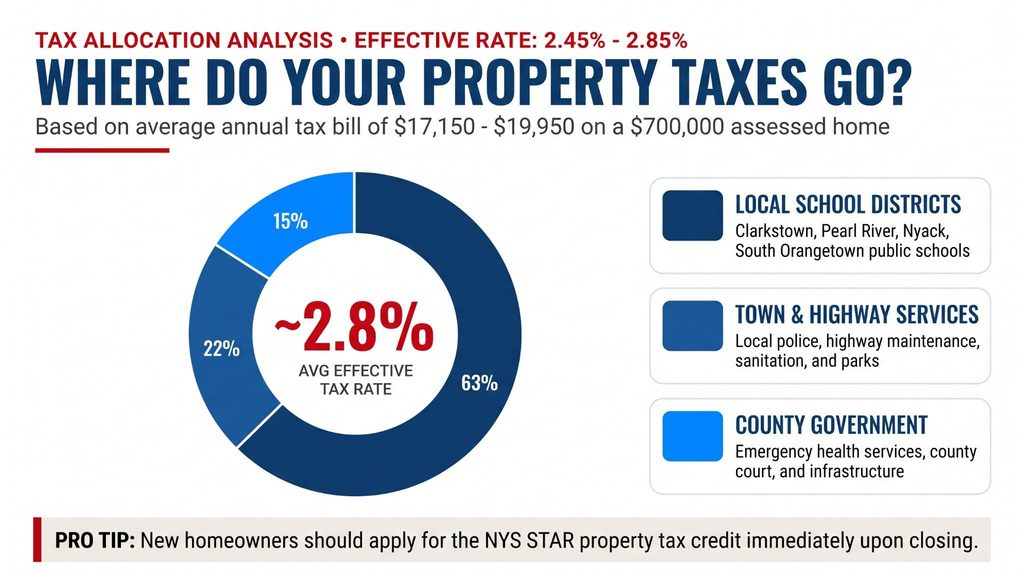
When calculating your monthly mortgage, the purchase price is only half the equation. Rockland County consistently ranks among the top 10 highest-taxed counties in the United States.
- Average Effective Property Tax Rate: ~2.45% – 2.85% (combined County, Town, and School taxes).
- What this means in practice: On a home valued at $700,000, your annual property tax bill will likely range between $17,150 and $19,950 per year ($1,430 – $1,660/month escrowed). School district taxes account for roughly 60%–65% of this total.
B. The Rental Market
For those leasing while searching for a permanent home or relocating for work, rental demand has driven rates to historic highs. According to the HUD Fair Market Rent (FMR) guidelines and regional rental indexes:
| Unit Type | Fair Market Rent (HUD) | Rockland Average Rent Range |
| Studio / 0-Bedroom | $2,409 | $1,850 – $2,250 |
| 1-Bedroom Apartment | $2,502 | $2,100 – $2,550 |
| 2-Bedroom Apartment | $2,787 | $2,700 – $3,250 |
| 3-Bedroom Single Family / Townhome | $3,477 | $3,400 – $4,200 |
- High-End Luxury Rentals: Newer riverfront developments (such as luxury mid-rises in Haverstraw, Nyack, or boutique complexes in Piermont) routinely command $3,100–$3,800/month for two-bedroom units with amenities.
- Value Pockets: Traditional garden-style complexes in Spring Valley, Suffern, or Nanuet offer more modest price points, frequently hovering closer to $1,950–$2,200 for 1-bedroom layouts.
2. Utilities & Household Energy Costs
Rockland experiences full four-season weather, meaning utility bills swing with the seasons:
| Utility Service | Average Monthly Cost | Local Provider Notes |
| Electricity & Natural Gas | $260 – $380/mo (combined) | Orange & Rockland Utilities (O&R). Winter gas bills can peak near $350-$450 for detached homes. |
| Heating Oil (if applicable) | $1,800 – $2,800/season | Common in older colonial and mid-century homes not converted to natural gas. |
| Water & Sewer | $65 – $110/mo | VEOLIA Water New York (formerly SUEZ). |
| High-Speed Internet / Cable | $75 – $135/mo | Verizon Fios (widespread fiber optic) and Optimum by Altice. |
| Trash / Recycling Collection | $35 – $55/mo | Handled via town tax assessments in some hamlets, or private municipal hauler contracts. |
3. Transportation & Commuter Costs
Most Rockland households rely on personal vehicles (averaging 1.8 to 2 cars per household), but NYC-bound commuters face toll and transit variables that directly impact monthly budgets.
Commuter Options & Tolls
- Driving to NYC:
- Gov. Mario M. Cuomo Bridge (Tappan Zee): E-ZPass passenger car toll is $6.00–$7.75 (peak/non-peak) eastbound; Rockland resident discounts are available with qualifying E-ZPass accounts (~$3.45).
- George Washington Bridge (I-95): Entering NYC costs $13.38–$17.63 via E-ZPass depending on peak hours.
- Monthly Gas & Parking in Manhattan: $400 – $800+ if driving daily.
- Public Transit to NYC (Midtown / Lower Manhattan):
- Metro-North (Hudson Line via Tarrytown): Many residents drive across the Cuomo Bridge to park at Tarrytown station ($350–$425/month for rail pass + monthly station parking permit).
- NJ Transit / Metro-North Pascack Valley Line: Serves Pearl River, Nanuet, and Spring Valley with connections to Hoboken and Penn Station ($290–$340/month pass).
- Hudson Link Bus: Connects Rockland Park-and-Ride hubs (Palisades Center, Lot H) across the bridge to White Plains and Tarrytown ($2.75/ride or $90/month).
- Haverstraw-Ossining Ferry: Connects Haverstraw commuters to Metro-North Hudson Line trains across the river ($43.75 for a 10-trip ticket or unified rail-ferry monthly passes).
4. Food, Groceries & Dining
Rockland residents enjoy diverse grocery options, from standard discount chains to upscale gourmet grocers.
A. Everyday Grocery Expenses
According to consumer price indexes, grocery spending in Rockland sits approximately 8.2% above the national median. A typical family of four spends between $950 and $1,350 per month.
| Item | Average Rockland Price |
| Whole Milk (1 gallon) | $4.25 – $4.65 |
| Eggs (1 dozen, Grade A Large) | $3.80 – $4.95 |
| Sliced White/Wheat Bread (1 loaf) | $3.25 – $4.10 |
| Boneless, Skinless Chicken Breast (per lb) | $4.75 – $5.99 |
| Ground Beef (85/15 per lb) | $5.99 – $7.49 |
| Coffee (12 oz bag) | $8.50 – $12.00 |
- Store Landscape: Everyday shoppers visit ShopRite (Pearl River, West Nyack, Tallman) and Stop & Shop. High-end and specialty shoppers frequent Wegmans (just over the border in Montvale, NJ), Trader Joe’s (Florham Park/Hartsdale or Westwood), and Whole Foods (Woodcliff Lake/West Nyack). Budget staples include Aldi (Nanuet) and BJ’s Wholesale Club (West Nyack).
B. Dining Out
- Casual Lunch / Deli Sandwich: $12 – $18 per person (a Rockland hot pastrami or chicken cutlet wedge).
- Mid-Range Dinner for Two: $75 – $125 (casual Italian, local taprooms, or pub fare including drinks).
- Fine Dining on the Hudson (Nyack/Piermont): $160 – $250+ for two with wine.
5. Healthcare Costs
Rockland County benefits from well-regarded medical centers including Montefiore Nyack Hospital and Good Samaritan Hospital (Suffern), with easy access to specialized health systems in Westchester and NYC.
- Average Individual Health Plan (NY State of Health Exchange, Silver Tier): $620 – $890/month (unsubsidized).
- Family Coverage: $1,650 – $2,300/month.
- Average Primary Care Copay: $25 – $50.
- Dental Checkup & Cleaning: $120 – $190 out of pocket.
6. Childcare & Education
Rockland’s public schools are among the state’s main draws, offering high per-pupil spending and robust AP/athletics programs.
Public School Districts
School districts like Clarkstown Central, South Orangetown, Pearl River, and Nyack rank consistently well on statewide metrics. While public school is tuition-free, real estate values directly reflect district boundaries.
Early Childcare & Preschool
For families with toddlers or infants, childcare represents a major monthly outlay:
- Full-Time Infant / Toddler Daycare: $1,400 – $2,100 per month per child.
- Part-Time Preschool (Ages 3–4): $700 – $1,200 per month.
- Private Nanny (Live-out): $22 – $32 per hour.
- Private / Parochial K-12 Tuition: $9,500 to $28,000+ per year (such as Albertus Magnus High School or local private academies).
7. State & Local Taxes
New York’s progressive tax structure shapes overall take-home earnings:
- NY State Income Tax: Rates range from 4.0% to 10.9% across income brackets (most middle-to-upper-income families pay in the 5.5%–6.5% effective bracket). Note: Unlike NYC residents, Rockland County residents do not pay a municipal city personal income tax.
- Combined Sales Tax: 8.375% (4.0% NY State + 4.0% Rockland County + 0.375% Metropolitan Commuter Transportation District surcharge).
- Annual Vehicle Registration & Inspection: ~$26–$70 every two years (weight-based) plus $21 annual NYS Safety & Emissions Inspection.
8. Lifestyle, Fitness & Entertainment
Beyond the essentials, personal discretionary expenses align with greater New York metro norms:
- Gym Memberships: $25–$45/month for standard fitness chains (Planet Fitness, Blink); $85–$160/month for boutique clubs, CrossFit boxes, or the JCC Rockland.
- Movie Ticket (Palisades Center AMC or Nanuet Regal): $15.50 – $18.50 per adult.
- Youth Sports League Fees: $150 – $400 per child per seasonal program.
- State Park Passes: NY State Empire Pass ($80/year), offering unlimited vehicle access to Rockland Lake, Bear Mountain, and Nyack Beach State Parks.
Pro-Tips for Managing Living Costs in Rockland
- Leverage the NY STAR Exemption: If you buy a primary residence, register immediately for the School Tax Relief (STAR) Credit, which delivers hundreds of dollars in direct school property tax rebate checks annually.
- Shop Cross-Border in Bergen County, NJ: Rockland borders Bergen County, NJ. While Bergen has blue laws closing retail on Sundays, everyday clothing and shoes in New Jersey carry 0% sales tax (compared to 8.375% in NY), saving money on back-to-school and wardrobe shopping.
- Explore Transit Tax Incentives: If commuting to Manhattan, use pretax commuter dollars (IRS Commuter Benefits) to pay for your Metro-North or Hudson Link passes.
- Compare Towns Along the North-South Axis: If top-bracket prices in Clarkstown or Orangetown stretch your budget, look into Suffern, Stony Point, or Congers, which frequently offer slightly lower entry costs while maintaining quiet, family-friendly neighborhoods.
In Comparison: Rockland County vs Neighboring NY Counties
Rockland vs. Westchester County: The Hudson Divide
- Housing & Value: Westchester is consistently 15%–25% more expensive than Rockland. Median home prices in Westchester routinely approach the mid-$900Ks, and prime lower-county towns (Scarsdale, Rye, Bronxville) sit well above $1.5M–$2M. Rockland offers larger acreage, detached single-family homes, and quieter neighborhoods for substantially less per square foot.
- Transit & Commuting: Westchester has the upper hand on mass transit speed. With three direct Metro-North lines (Hudson, Harlem, New Haven) running straight into Grand Central, the rail commute is faster and simpler. Rockland commuters heading to the East Side of Manhattan must either drive across the Cuomo Bridge to park at Tarrytown/White Plains or rely on NJ Transit into Penn Station/Hoboken.
- Taxes: While Rockland’s effective tax rate is slightly higher as a percentage of assessed value, the sheer magnitude of Westchester’s home valuations often results in equal or higher gross tax bills ($20,000–$30,000+/year on comparable square footage).
Rockland vs. Orange County: Affordability vs. Proximity
- Housing & Space: Orange County (Middletown, Monroe, Newburgh, Warwick) is the clear winner for upfront affordability, with home prices roughly 40% lower than Rockland. You will get larger lot sizes, newer builds, and lower monthly rents.
- Tolls & Commute Time: The trade-off is distance. Commuting to NYC or lower Westchester from Orange County means 75 to 110+ minutes each way via Route 17/I-87 or the Port Jervis train line. Rockland cuts that commute in half, saving significant monthly fuel, toll, and transit wear-and-tear.
- Property Taxes: Like Rockland, Orange County has high effective tax rates (frequently 2.6%–2.9%), but because base property assessments are lower, the raw dollar amounts are easier on a monthly budget.
Thinking About Moving to Rockland County?
Relocating to Rockland requires planning beyond the spreadsheet. From navigating the tight, hilly historic avenues of Nyack to coordinating condo move-ins in Haverstraw or maneuvering moving trucks down quiet, tree-lined cul-de-sacs in New City, local logistics require care.
At Slattery Moving & Storage, we have served Hudson Valley families and incoming NYC transplants for decades. Our team handles every detail, from comprehensive full-service packing and clean, temperature-regulated storage facilities to delicate furniture moving and building COI (Certificate of Insurance) coordination.
- Relocating from NYC or out of state? Request a Guaranteed Quote from Slattery Moving or call our local dispatch team to schedule a custom in-home or virtual estimate.
Final Thoughts: Is Rockland County Worth It?
Living in Rockland County isn’t low-cost. With household bills running 61% above the national median and property taxes that require serious consideration, settling here is an intentional investment.
In return, you secure expansive suburban space, an easy ~45-minute connection to Manhattan, scenic riverside vistas, and high-performing school systems. By understanding the real monthly numbers before you buy or lease, you can step into your Hudson Valley move with total financial clarity.
Frequently Asked Questions (FAQs): Cost of Living in Rockland County
1. What salary do you need to live comfortably in Rockland County?
To live comfortably as a homeowner with a median-priced home (~$765,000), property taxes, and typical household bills, a household generally needs an annual gross income of $185,000 – $220,000.
For renters sharing a 2-bedroom apartment ($2,700/month), landlords typically look for the standard 40x monthly rent rule, meaning a minimum household income of $108,000 – $120,000.
2. Why are property taxes so high in Rockland County?
Rockland County property taxes are driven primarily by its independent school districts (such as Clarkstown, Pearl River, and Nyack), which account for 60% to 65% of the total tax bill. New York State relies heavily on local property taxes to fund public education rather than statewide income tax redistribution. The remainder funds municipal services, highway maintenance, police departments, and county administration across its five towns.
3. Which towns in Rockland County are the most affordable?
If you are looking for entry-level home purchases or lower rental rates:
- Haverstraw and West Haverstraw: Feature the lowest median home prices ($460,000–$540,000) and entry-level rents, with the added perk of the Haverstraw-Ossining commuter ferry.
- Suffern: Offers competitive co-op, condo, and starter single-family pricing ($550,000–$620,000) along with its own direct NJ Transit train station and a walkable downtown.
- Spring Valley: Has some of the county’s lowest apartment rental rates, typically averaging under $2,100 for 1-to-2-bedroom layouts.
4. Which towns in Rockland County are the most expensive?
The most exclusive real estate sits along the Hudson River and in select equestrian/estate hamlets:
- Piermont & Grand View-on-Hudson: Riverfront luxury estates, historic homes, and waterfront condos often sell between $850,000 and $1,500,000+.
- Upper Nyack & Snedens Landing (Palisades): Known for private estates, historic architecture, and celebrity enclaves, with properties routinely exceeding $1.5M–$3M.
- Upper Saddle River Border / Montebello: Features modern luxury custom builds and multi-acre zoning.
5. Does Rockland County have an NYC local income tax?
No. New York City levies a municipal personal income tax (ranging from ~3.078% to 3.876%) strictly on individuals who reside inside the five boroughs. Moving from NYC to Rockland County eliminates that local city tax entirely, leaving you responsible only for New York State income tax and standard federal taxes.
6. Is it cheaper to live in Rockland County or New Jersey?
It depends on the town. Northern Bergen County towns directly across the border (e.g., Montvale, Saddle River, Upper Saddle River) have property taxes and home prices on par with or exceeding Rockland. However, New Jersey offers lower sales taxes on everyday retail (6.625% in NJ vs. 8.375% in Rockland) and 0% tax on clothing and footwear, which helps lower everyday living expenses.
[Callout Box: “Planning your Hudson Valley move? See how Slattery Moving & Storage can coordinate your relocation across Rockland, Westchester, or Orange County without the stress. [Get an Instant Moving Quote →]”]